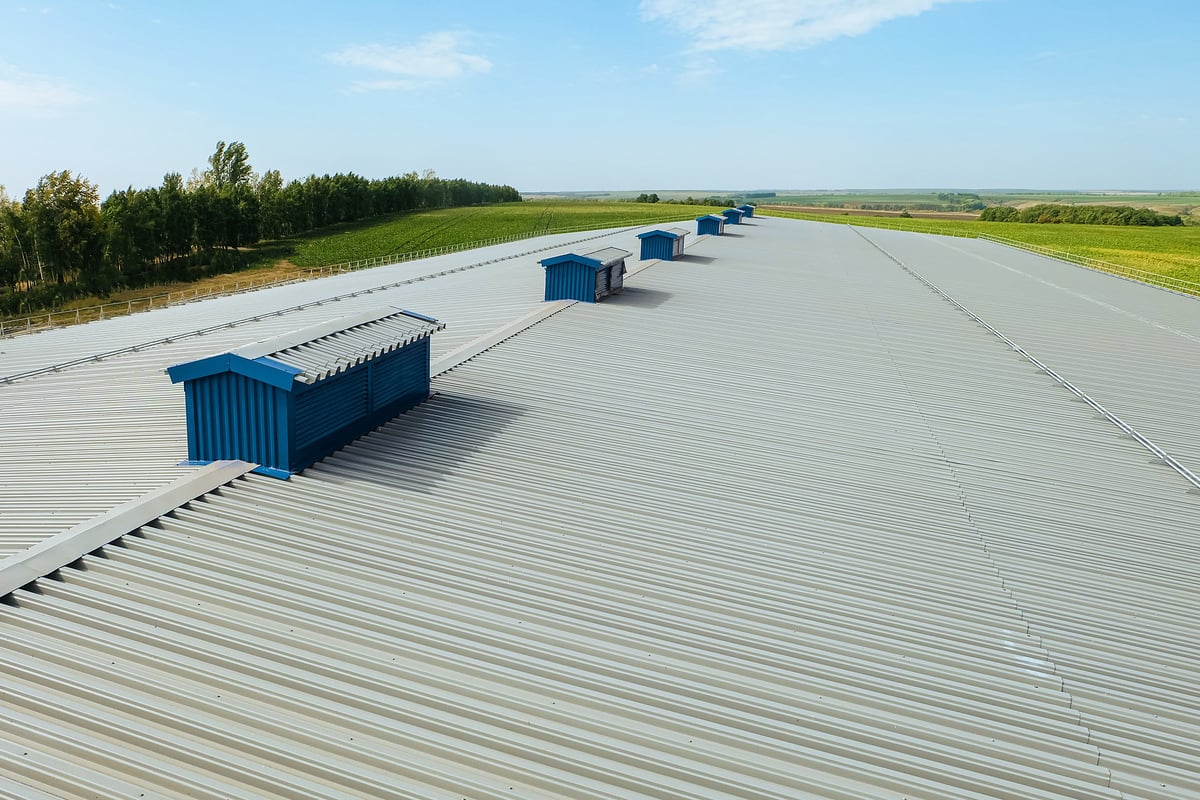
Commercial roof overcladding usually costs less upfront than full replacement because the existing roof covering remains in place. This reduces strip-out, disposal and weather-protection work. Full replacement can still be more cost effective over the building's remaining life when the existing roof, insulation or supporting structure has serious defects.
Business owners must also consider service life, maintenance, disruption, energy performance, asbestos, warranties and future solar panels. A roof survey should determine which solution fits the building.
Commercial roof overcladding, also called oversheeting or over-roofing, involves installing a new weatherproof covering above an existing roof. The original covering is retained rather than stripped away.
A typical system may include spacer rails fixed back to the supporting structure, additional insulation, a vapour-control strategy and new profiled metal sheets. Rooflights, gutters, flashings, penetrations and perimeter details may also need replacement or modification.
Overcladding should be treated as an engineered refurbishment system. It is not simply a matter of placing new sheets over an old roof. The existing structure must be checked for additional loading, and defects must be identified before they become concealed.
Full replacement removes the existing roof covering before installing a new system. Depending on the building, the work may also include removing old insulation, repairing or replacing parts of the deck and supporting structure, and renewing rooflights, gutters and drainage.
The process normally includes:
Full replacement exposes the underlying construction, allowing hidden corrosion, wet insulation and weak decking to be addressed.
Business owners considering either option should begin with ERS Energy's commercial roofing services, which explain the survey, specification and quotation process.
Overcladding normally has the lower initial price because it reduces removal, disposal and exposure of the building. Where asbestos cement can safely remain managed, avoiding full removal may significantly affect the price and programme.
However, an overcladding quotation must include everything necessary to create a complete system. Potential costs include structural calculations, spacer rails and fixings, additional insulation, new rooflights, gutter lining or replacement, flashings, safe-access systems, asbestos controls, repairs to existing defects, and Building Control requirements.
A low quotation that excludes gutters, fragile rooflights, structural repairs or asbestos controls cannot be compared fairly with a complete replacement proposal. Full replacement includes stripping, disposal and temporary protection. Asbestos can increase those costs further.
For businesses assessing local pricing factors, ERS Energy's guide to warehouse roof replacement costs explains why area alone is not enough to produce a reliable figure.
| Factor | Overcladding | Full replacement |
|---|---|---|
| Initial cost | Usually lower | Usually higher |
| Existing covering | Retained | Removed |
| Waste and disposal | Reduced | Greater |
| Operational disruption | Often lower | Usually higher |
| Hidden defects | May remain concealed | Can be exposed and repaired |
| Additional structural load | Added to the building | Old covering is removed |
| Asbestos | May remain managed in place | Can be removed |
| Insulation | Can often be upgraded | Complete redesign is possible |
| Future flexibility | Depends on retained build-up | Usually greater |
| Solar installation | Requires structural and system checks | Can be designed into the new roof |
| Long-term certainty | Depends heavily on existing condition | Usually provides greater certainty |
These are general differences. The survey findings must control the final decision.
Whole-life cost considers what the roof will cost to own, maintain and eventually replace, not only what it costs to install this year. An overclad system may offer strong value where the structure is stable, defects are limited and the new build-up receives a suitable warranty. Full replacement may offer better value where retaining the old roof transfers too much future risk.
If overcladding saves money now but requires early removal because of concealed corrosion or trapped moisture, the initial saving may be lost. If replacement creates unnecessary strip-out on a sound roof, the business may spend more than the building needs.
Overcladding may be appropriate when the supporting structure is sound and capable of carrying the additional load. The case is stronger where defects are limited and can be repaired, there is no evidence of widespread trapped moisture, the structure can support the proposed system, the building must remain operational, thermal performance can be improved, a manufacturer-backed system with suitable warranty is available, and the retained materials can be managed safely.
It is not a shortcut around proper investigation. Moisture testing, structural calculations and detailed inspection may still be required.
Full replacement becomes more attractive as uncertainty and deterioration increase. It may be better where the survey finds serious corrosion in supporting members, widespread water ingress, saturated insulation, weak or failing roof decks, extensive damage to asbestos-containing sheets, significant movement or deformation, major changes to the building's use, a requirement to remove long-term asbestos liability, or structural limitations affecting a future solar array.
Full replacement does not automatically mean that every supporting component must be discarded. A survey may find that the primary structure can remain while the defective coverings, insulation or deck sections are renewed.
Some asbestos cement roofs can be overclad, but the decision requires an asbestos survey, condition assessment and safe system of work. Overcladding does not remove the asbestos — it remains within the building and must continue to appear in the asbestos register and management plan.
HSE guidance explains that some slightly damaged asbestos-containing materials may be sealed or enclosed, while badly damaged material that cannot be protected may need removal. The appropriate decision must come from competent assessment rather than cost alone.
ERS Energy's guide to asbestos roof removal contractors provides further information on professional assessment and controlled removal.
It can if the investigation is inadequate. Before overcladding, the survey should investigate: active leaks and their true sources, corrosion around fixings and laps, condition of purlins and supporting members, wet or compressed insulation, condensation risks, weak or damaged rooflights, blocked or undersized drainage, and earlier repairs and incompatible materials.
Visible damage may represent only part of the problem. Water can travel within the roof build-up before appearing inside the building, while corrosion may be more advanced at hidden laps or beneath insulation.
Both approaches can improve thermal performance. Overcladding can create space for additional insulation between the existing covering and new external sheets. Full replacement allows wet or ineffective insulation to be removed and the entire roof build-up redesigned around current requirements.
A roof upgrade can contribute to a better EPC rating, but no contractor should guarantee a particular rating from roofing work alone.
Both an overclad roof and a fully replaced roof can support commercial solar when correctly designed. The project team should consider structural capacity for roof and solar loads, remaining service life, wind loading, warranty compatibility, safe maintenance routes, drainage, future panel removal, and grid-connection planning.
ERS Energy provides commercial solar panel installation alongside roofing services, allowing roof specification, usable solar area and mounting requirements to be assessed as one project.
Two proposals may use the same headline description while including very different work. Ask each contractor to identify: surveyed roof area, existing defects and repairs, structural calculations, proposed roof system and materials, insulation specification, rooflight details, gutter and drainage work, asbestos handling, access and scaffolding, Building Control responsibilities, weather protection, project programme, warranties, maintenance requirements, solar-ready design, and all exclusions, assumptions and provisional sums.
ERS Energy provides clear, itemised quotations after inspecting the site.
Commercial roof overcladding is often the lower-cost option at the start of a project. Full replacement may provide better whole-life value when the existing roof contains extensive damage, wet insulation, structural uncertainty or asbestos that the owner wants removed.
ERS Energy assesses commercial roofs before recommending a solution. Roofing, insulation and solar requirements can be coordinated through one team, with an itemised proposal explaining what is necessary and why.
Request a Commercial Roof Survey