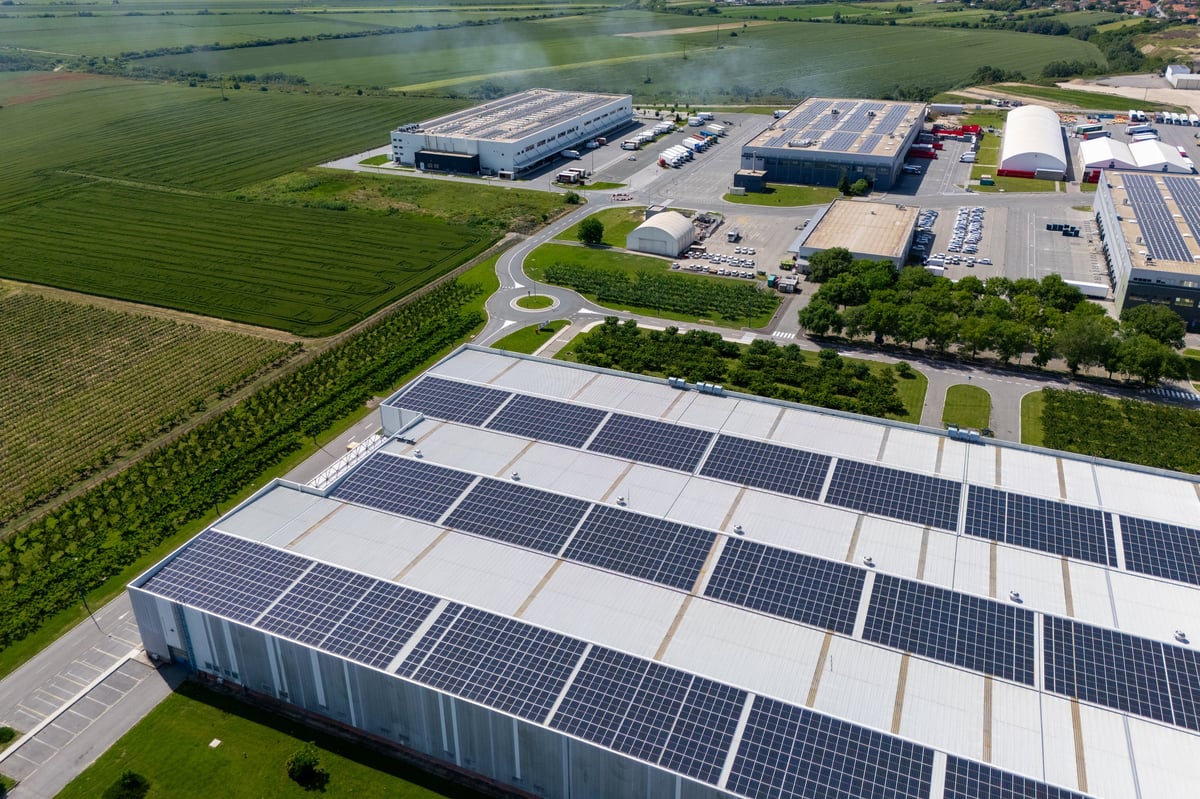
Yes, solar panels can help offset the cost of a new commercial roof through lower electricity bills and, in some cases, income from exported electricity. They do not normally pay the roofing invoice upfront, and they may not recover the full roof cost. The benefit builds over time as the business purchases less electricity from the grid.
For a warehouse, factory or industrial unit that already needs roof replacement, combining roofing and solar can turn a necessary expense into a wider energy investment. The result depends on the building, its daytime electricity use and the assumptions used in the forecast.
Solar panels help recover part of a commercial roof investment by reducing the amount of electricity the business must buy. If the building uses electricity while the panels are generating, that solar power can be consumed on site rather than purchased from an energy supplier.
This is the main source of value. Each unit of solar electricity used inside the building avoids buying a unit from the grid. The exact saving depends on the business electricity tariff and any time-based charges that apply.
If the system generates more power than the building can use, some surplus may be exported. Eligible installations may receive export payments, but export rates and requirements vary. Export income should be calculated separately and should not be presented as a guaranteed saving.
Solar can offset or help recover part of the roof cost. Claims that it automatically provides a free roof ignore finance costs, performance and energy-use patterns.
Installing solar on a commercial roof with limited remaining life can create an avoidable future expense. When that roof eventually requires replacement, the panels, mounting system and electrical components may need to be removed, stored and reinstalled.
Planning the two projects together allows the roofing system and solar array to be designed as one coordinated investment. The survey can consider roof condition, structural capacity, insulation, drainage, access, shading, usable area and the proposed mounting method.
The advantages can include:
Businesses considering a combined project can first review ERS Energy's commercial roofing services to understand what a roof survey and replacement specification should cover.
A useful assessment should show how the savings have been calculated, not simply provide a payback headline. The calculation normally begins with the proposed system size and its estimated annual generation.
The next step is to compare expected generation with the site's electricity use. Half-hourly consumption data is particularly valuable because it shows when the business uses power. A business that operates machinery, lighting, refrigeration, ventilation or charging equipment during the day may use a high proportion of its solar generation directly.
A simplified calculation is:
Consider a hypothetical system expected to generate 100,000 kWh in a year. If the business can use 75,000 kWh on site, those units replace electricity it would otherwise purchase. The remaining 25,000 kWh may be exported, curtailed or stored, depending on the system design and commercial arrangements.
The value of the 75,000 kWh depends on the electricity tariff avoided. The exported portion usually has a different value. A credible forecast will state both rates, identify whether they are fixed assumptions and show what happens if prices or consumption change.
The calculation should separate the roof cost from the solar cost so the expected return remains clear.
Two similar warehouses can produce very different financial results. Roof area alone does not determine whether solar will help pay for a new commercial roof.
Self-consumed solar electricity is normally more valuable than exported electricity because it replaces electricity bought at a business tariff. Manufacturing sites, refrigerated facilities, workshops and offices with consistent daytime demand may therefore present a stronger opportunity.
Rooflights, vents, plant, access routes, shading and required safety distances reduce the area available for panels. The maximum number of panels that physically fits is not necessarily the correct system size.
Orientation, pitch and nearby obstructions affect expected output. Flat commercial roofs can offer design flexibility, but panel spacing, ballast, wind loading and access requirements must be considered.
The roof must be assessed for condition, remaining life and structural capacity. Corrosion, recurring water ingress, fragile materials or a weak deck can change the recommended scope.
The value of every unit used on site depends on what the business would otherwise pay. Forecasts should use an identifiable tariff assumption and should not rely on indefinite energy-price growth.
The local Distribution Network Operator may set conditions on how much power can be connected or exported. Required network work can affect cost and timing, particularly for larger systems.
A business purchasing the system directly faces a different cash-flow profile from one using asset finance, a lease or a power purchase arrangement. Interest, fees, contract length and ownership terms must be included when comparing options.
The approach is strongest when the roof already requires substantial work and the business expects to occupy or own the property long enough to benefit from the savings.
Suitable buildings often include warehouses, manufacturing facilities, distribution centres, workshops and large offices. These properties can have broad roof areas and meaningful daytime demand.
The following conditions strengthen the case:
ERS Energy's commercial solar panel installation service explains how roof space, orientation and actual energy use should inform the proposed system.
Solar is not equally suitable for every commercial property. A responsible assessment should identify weak cases rather than force every building into the same proposal.
Savings may be limited where the business uses little electricity during daylight hours, the roof is heavily shaded or the usable area is small. A tenant with a short remaining lease may also lack enough time or contractual control to justify the investment.
High structural reinforcement costs can affect the business case. So can an expensive grid connection, a poor export arrangement or a solar array sized far above the site's realistic demand.
The proposal should include sensitivities showing what happens if generation, electricity prices or on-site consumption are lower than expected. This gives the decision-maker a range rather than a single optimistic outcome.
The answer depends on the roof's remaining life and condition. A roof does not always need complete replacement before solar, but it should be surveyed before the system is designed.
Recurring leaks, widespread corrosion, damaged rooflights, saturated insulation and failing membranes may indicate that significant roofing work is required. Installing panels without resolving those issues can make future repairs slower and more expensive.
Where the roof structure is sound, targeted repairs or encapsulation may be considered. Where deterioration is extensive, replacement can provide a better long-term base for the solar installation. The decision should follow evidence from the survey rather than a general rule.
After completion, planned commercial roof maintenance and inspections can help identify roof or mounting issues before they become disruptive failures.
An asbestos-containing roof requires specialist assessment before roofing or solar work begins. Panels should not simply be fixed through fragile asbestos cement sheets. Drilling, cutting or disturbing asbestos-containing materials can release hazardous fibres and create legal and safety risks.
The appropriate route depends on the type, condition and location of the asbestos-containing material. Options may include professional management, encapsulation or overcladding where suitable, or controlled removal and roof replacement.
The solution must account for structural performance, safe access, regulatory duties and the solar mounting method.
Some qualifying UK companies may be able to claim Land Remediation Relief for eligible expenditure connected with cleaning up contaminated land or buildings. Eligibility is fact specific, so the business should seek advice from a qualified tax professional before including any relief in the project budget.
Export payments can add value when the solar system produces more electricity than the premises can use. They should normally be treated as a secondary part of the business case rather than the main justification for installing an oversized system.
The Smart Export Guarantee requires participating electricity suppliers to offer eligible small-scale low-carbon generators an export tariff. Eligibility, metering and application requirements apply, and the rate depends on the supplier and product selected.
The first objective should be to match generation with on-site demand. The proposal should state expected self-consumption, export volume and tariff assumptions separately.
Battery storage can hold surplus solar electricity for use later. It may be helpful where generation is strongest around midday but the building continues using significant power in the evening or during high-price periods.
A battery may support other operational objectives, but it does not automatically improve the financial return.
The assessment should consider usable capacity, charge and discharge rates, expected cycling, degradation, warranty, energy losses and the difference between buying, storing and exporting electricity. If the site already consumes most solar generation as it is produced, a battery may add cost without capturing enough extra value.
Battery storage should therefore be sized using interval consumption data and a clear operating strategy, not added as a default extra.
Businesses may pay from available capital, use asset finance, or consider lease and power purchase arrangements. They should compare the total payable, fees, ownership terms, responsibilities and maintenance costs, not only the monthly payment.
Tax allowances may reduce the effective cost for eligible businesses and expenditure, but the treatment of roofing, solar and other building work can differ. An accountant should confirm the position before tax savings are included in the approval case.
Local schemes may occasionally be available. Confirm current eligibility and approval conditions before work begins.
Before committing to a combined roof and solar installation, ask:
Completed commercial roofing and solar projects can also help decision-makers understand how combined work is planned on active business premises.
Solar panels can help pay for a new commercial roof, but only in the sense that future energy savings can offset part of the combined cost. The roof still needs an appropriate specification, and the solar forecast must use realistic assumptions.
ERS Energy brings commercial roofing and solar together within one assessment and one coordinated proposal. The system is designed around the building's roof condition, usable area and actual energy demand, with clear, itemised costs rather than an unexplained headline saving.
Request a Combined Roof and Solar Survey